⚞ The Highlights:
- Water bottle labels should be a waterproof plastic film (BOPP, PET, or vinyl), not paper, because the bottle gets wet, cold, and handled constantly.
- The adhesive matters as much as the material. You need a permanent, moisture-resistant adhesive that can grip a cold, condensation-covered bottle.
- Waterproof and water-resistant aren’t the same thing. A water bottle label needs to be genuinely waterproof, often with a laminate on top.
- Common labels for a standard 16.9 oz bottle run around 8 inches wide by 2 inches tall, but the exact size depends on your bottle. Measure before you design.
- Print quality comes down to the material, the press, and color accuracy. Clear film gives that popular “no-label look,” while white film keeps colors bold and true.
The best water bottle labels are made from a waterproof plastic film, BOPP, PET, or vinyl, paired with a permanent, moisture-resistant adhesive. Paper labels don’t hold up, because a water bottle spends its life wet, cold, and handled. The label has to survive condensation, ice baths, coolers, and wet hands without peeling, bubbling, or turning to mush.
We print a lot of beverage labels, and water bottles are one of the least forgiving surfaces there is. A label that looks great in a design file can fall apart the first time the bottle sweats. Here’s how to choose the material, adhesive, size, and print that will actually hold up, plus the condensation problem that catches most brands off guard.
What material is best for water bottle labels?
Water bottle labels should be a waterproof film, not paper. The three materials that dominate are BOPP, PET, and vinyl. Each is waterproof and durable; they differ in clarity, feel, and cost.
Why paper struggles on water bottles
Paper is porous, so it soaks up moisture. On a bottle that’s constantly sweating or sitting in ice, a standard paper label wrinkles, discolors, and peels, exactly the “soggy label falling to pieces” problem beverage brands dread. There are wet-strength coated papers that do better, but for a bottle that gets wet by design, a plastic film is the safer choice.
BOPP
BOPP (biaxially-oriented polypropylene, a type of durable plastic film) is the workhorse of water bottle labels. It’s fully waterproof and shrugs off moisture and chemicals. It handles temperature swings, comes in white, clear, and metallic, and doesn’t cost much. For most bottled water and beverage brands, BOPP is where we usually start.
PET (polyester)
PET film is strong and exceptionally clear. It’s also dimensionally stable, which is a technical way of saying it holds its shape and doesn’t distort. It resists UV well, so it’s a good pick when bottles will see sunlight, and it’s recyclable. PET is a step up when you want a durable, crystal-clear label.
Vinyl
Vinyl is tough, waterproof, and conformable, so it wraps curves and irregular shapes without wrinkling. It also holds up to sunlight and chemicals. It usually costs more than BOPP, but it’s a strong choice for bottles that face rough handling or the outdoors. It’s also the material behind most “sticker” style water bottle labels.
|
BOPP |
PET (polyester) |
Vinyl |
| Waterproof |
Yes |
Yes |
Yes |
| Clarity |
Good (clear option) |
Excellent |
Good |
| Durability |
High |
High, very stable |
Very high, conformable |
| Relative cost |
Low to mid |
Mid |
Mid to high |
| Best for |
Most bottled water and beverage brands |
Premium, crystal-clear looks; sun exposure |
Rugged handling, outdoors, sticker-style labels |
Clear, white, or metallic?
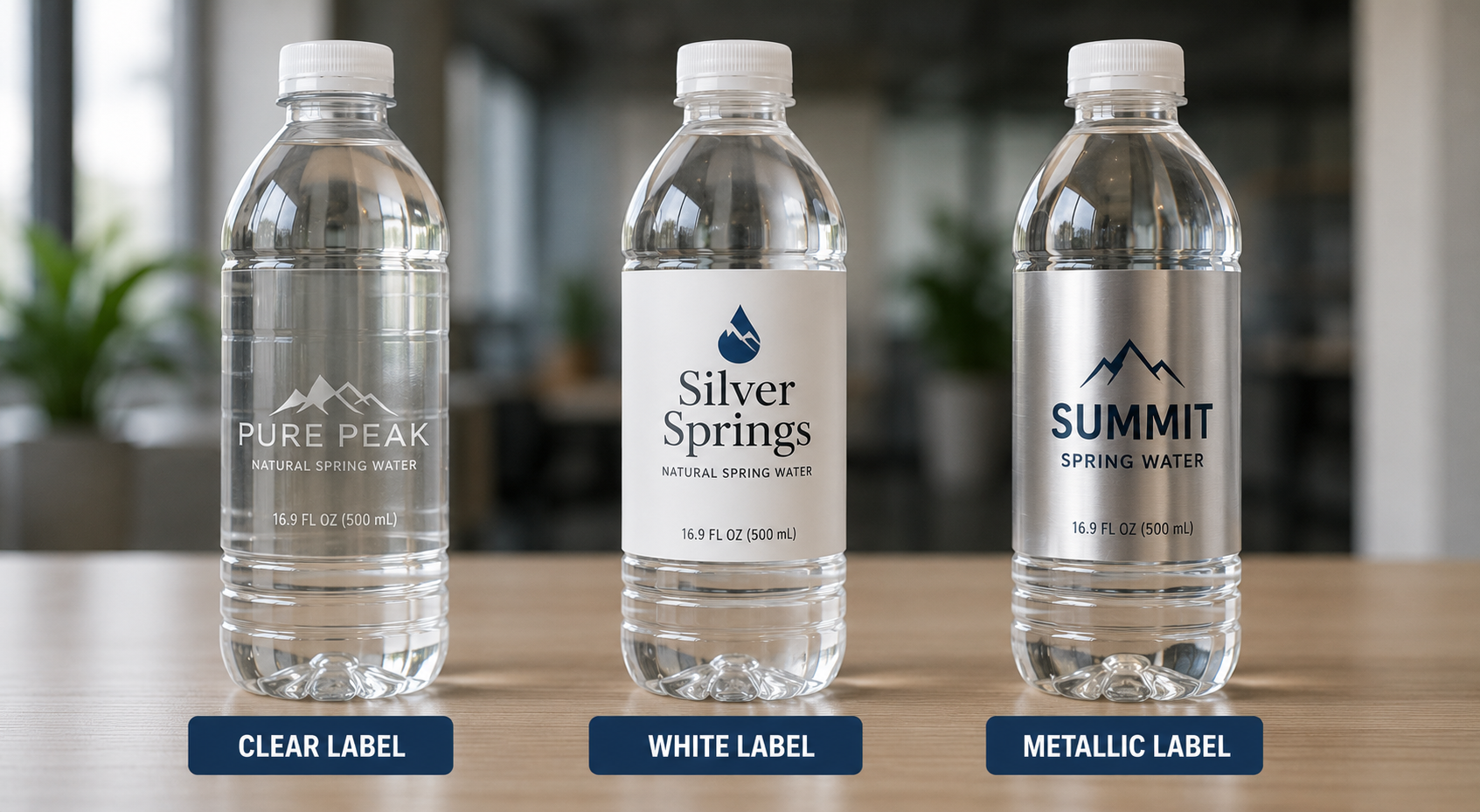
The film color shapes the whole look. Clear film gives the popular “no-label look,” where the design appears printed right on the bottle (this usually needs a printed white layer behind the colors so they stay opaque). White film makes colors bold and consistent regardless of what’s in the bottle. Metallic film adds shine for a premium feel. For a printer’s take on the clear look, see our guide on comparing BOPP vs. vinyl.
Waterproof vs. water-resistant: what’s the difference?
This distinction matters more for water bottles than almost any other product. Water-resistant means a label can handle some splashing or brief exposure. Waterproof means it survives sustained moisture, immersion, ice, and condensation without failing. A water bottle label needs to be genuinely waterproof, which usually means a plastic film, a moisture-resistant adhesive, and often a laminate or waterproof coating over the print to protect the ink. If a supplier only promises “water-resistant,” ask what happens after an hour in a cooler.
Application and adhesive
The material gets the attention, but the adhesive is where water bottle labels quietly succeed or fail. It has to bond to a smooth plastic or glass surface and hold through everything the bottle goes through.
Choosing the right adhesive
Adhesive choice depends on the bottle surface and the conditions. Acrylic-based permanent adhesives generally perform better than rubber-based ones in heat and moisture, which makes them a common pick for beverages. The adhesive also has to match the surface. Plastic (PET bottles), glass, and aluminum each behave a little differently.
The condensation problem
Here’s the detail generic guides miss: water bottles are often labeled cold, or they get cold and wet in use, and moisture is the enemy of adhesion. A standard adhesive applied to a chilled, condensation-covered bottle may never fully bond, so the label lifts at the edges later. If your bottles are filled or labeled cold, or they’ll live in ice and coolers, you need an adhesive rated for damp or low-temperature application. This is one of the first things we check when a beverage label is coming apart in the field, and it’s almost always fixable by matching the adhesive to how and when the bottle gets labeled.
Worth knowing: “The label keeps peeling” is usually an adhesive-and-application problem, not a material problem. Tell your printer whether the bottle is labeled warm or cold, wet or dry, and whether it’ll sit in ice. That one detail drives the adhesive choice more than anything else.
Permanent vs. removable adhesive
Permanent vs. removable adhesive
Most water bottle labels use a permanent adhesive so they stay put for the life of the bottle. A removable adhesive makes sense for reusable bottles, promotional or event bottles guests might want to peel, or recycling programs where the label needs to come off cleanly. Decide which fits your use before you order, because switching later means a new run.
Need water bottle labels that survive the cooler?
Tell us how your bottles get filled, labeled, and stored, and we’ll match the material and adhesive so your labels don’t peel or bubble in the field.
Request a Quote Get a Sample Pack
What size should a water bottle label be?
Label size depends on your specific bottle, but there are common starting points. Measuring your bottle first saves a costly re-do.
Common water bottle label sizes
For a standard 16.9 oz (500 mL) water bottle, a wrap-around label is often around 8 inches wide by 2 inches tall, though the exact dimensions vary by bottle brand and shape. Smaller bottles and taller “slim” bottles use different sizes. Rather than copy a number, it’s best to size the label to your actual bottle.
How to find your bottle’s label size
- Width: measure the circumference of the bottle where the label sits, then subtract a small gap so the ends don’t overlap awkwardly (unless you want a full wrap that seams).
- Height: measure the flat labeling area between the shoulder and the base curve, then leave a little margin top and bottom.
- Check the curve: bottles narrow at the top and bottom, so keep the label on the straight section where it lies flat.
When in doubt, send your bottle specs (or the bottle itself) to your printer and they can confirm the right dimensions and provide a template.
Print quality
Once material and size are set, print quality is what makes the label look cheap or premium. A few things drive it.
What makes a water bottle label look premium?
Sharp resolution, clean edges, and the right finish. A glossy finish looks wet and vibrant (fitting for water), while a matte finish reads more premium and modern. Because clear labels are so common on water, getting a crisp printed white layer behind the design is often what separates a professional clear label from a washed-out one.
Color accuracy
Consistent color is what makes a brand look legit on a shelf and across reorders. Our HP Indigo presses match a high percentage of Pantone colors, which helps your brand colors stay true from run to run. If exact color match matters to your brand, ask for a printed proof on your actual material before the full run.
Sustainability considerations
Sustainability is increasingly part of the water category, sometimes ironically, given the plastic-bottle conversation. On the label side, BOPP and PET are recyclable. Water-based and soy-based inks are gentler on the environment, and digital printing uses only the ink a job needs, with less setup waste. Removable adhesives can also help, since a label that comes off cleanly makes the bottle easier to recycle. If eco-friendly positioning is part of your brand, it’s worth building into the label spec, not just the messaging.
What do water bottle labels cost?
There’s no single price. Cost depends on the material (BOPP is typically the most economical, vinyl the priciest), the size, the run quantity (per-label cost drops as the run grows), the number of colors and finishes, and any lamination. For custom or private-label water, where runs are often smaller, digital printing keeps the per-label cost reasonable at lower quantities. The fastest way to a real number is to share your bottle, quantity, and design.
Frequently asked questions
What material is best for water bottle labels?
A waterproof plastic film is best, not paper. The three common options are BOPP (the cost-effective default for most beverage brands), PET or polyester (very clear and dimensionally stable, good UV resistance), and vinyl (highly durable and conformable, usually the priciest). All three are waterproof; they differ in clarity, feel, and cost.
Are water bottle labels waterproof?
They should be. A water bottle label needs to be genuinely waterproof, not just water-resistant, because the bottle sweats, sits in ice, and gets handled with wet hands. That usually means a plastic film, a moisture-resistant permanent adhesive, and often a laminate or coating over the print to protect the ink.
Why do my water bottle labels keep peeling?
Peeling is usually an adhesive-and-application problem, not a material problem. Water bottles are often labeled cold or get cold and wet, and moisture prevents a standard adhesive from bonding, so edges lift later. If bottles are filled or labeled cold or stored in ice, use an adhesive rated for damp or low-temperature application, and match the adhesive to the bottle surface.
What size is a water bottle label?
For a standard 16.9 oz (500 mL) bottle, a wrap-around label is often around 8 inches wide by 2 inches tall, but the exact size depends on the bottle. Measure the circumference where the label sits for the width and the flat area between the shoulder and base for the height, then leave a small margin. Ask your printer for a template based on your specific bottle.
Should water bottle labels be clear or white?
Clear film gives the popular no-label look where the design appears printed on the bottle, but it usually needs a printed white layer behind the colors so they stay opaque. White film makes colors bold and consistent regardless of what’s in the bottle. Metallic film adds a premium shine. The choice depends on the look you want.
Can you use removable labels on water bottles?
Yes. Most water bottle labels use a permanent adhesive so they stay put, but a removable adhesive makes sense for reusable bottles, promotional or event bottles that guests might peel, or recycling programs where the label should come off cleanly. Decide before you order, since switching adhesive types means a new run.
Ready to print your water bottle labels?
Whether it’s bottled water for retail, private-label bottles for an event, or a new beverage brand, we’ll help you pick the material, adhesive, and finish that survive real-world conditions. Request a sample pack to feel the waterproof films, or get in touch with your bottle and quantity for a quote.
More on beverage and waterproof labels: