What’s Required on a Supplement Facts Panel?
- Labels
- supplement facts
- supplement labels
- supplements
If you make or sell dietary supplements, your label isn’t complete without a compliant Supplement Facts panel, that black-and-white box that spells out exactly what’s inside your product.
Every line, unit, and rule in that box is dictated by the FDA. Miss something, and you could end up reprinting your labels, delaying shipments, or getting flagged during inspection.
Here’s what needs to go on your Supplement Facts panel:
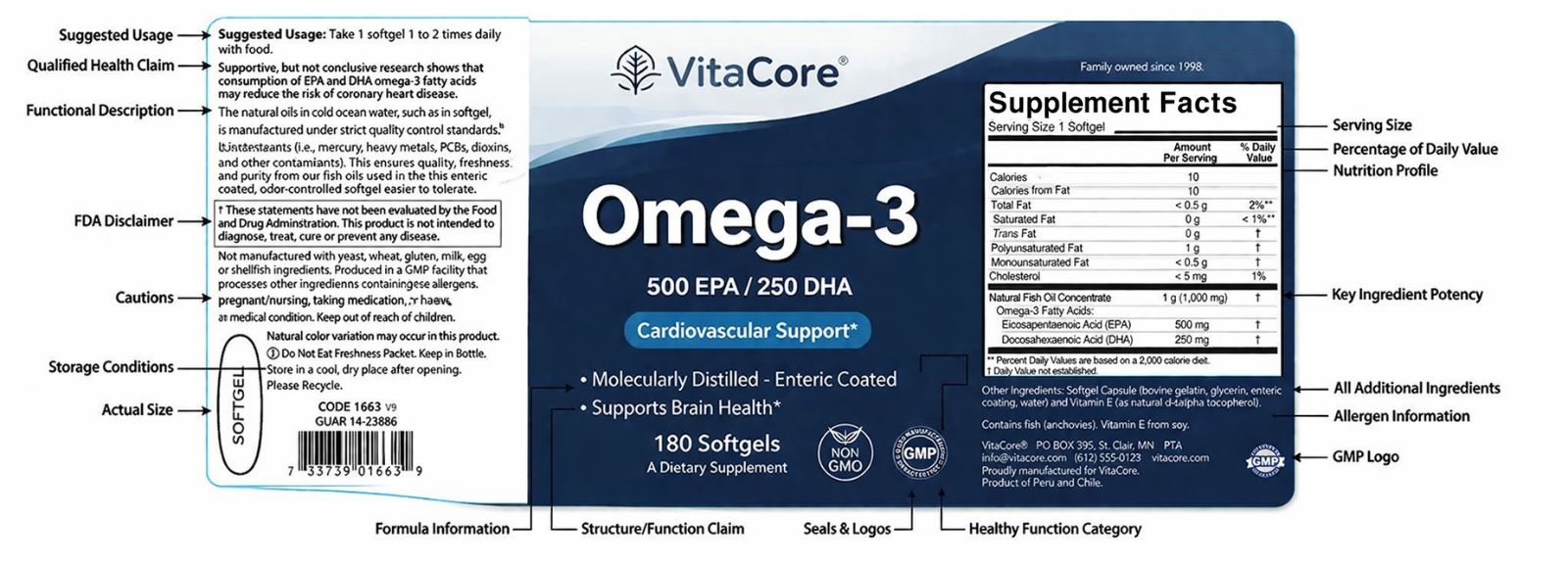
The Title: “Supplement Facts”
The heading must say “Supplement Facts” in bold type across the top of a boxed section on your label. No creative alternatives or substitutions. It has to be this exact phrase.
The box itself needs to be clearly outlined so anyone, including the FDA, can spot it right away. Think of it as the “nutrition label” of the supplement world, just with a different set of rules.
Serving Size and Servings Per Container
These two lines sit right under the title and set the tone for the rest of the panel:
- Serving Size: How much a person takes in one serving (like “1 capsule,” “2 gummies,” or “1 scoop”).
- Servings Per Container: The total number of servings in the bottle or pouch.
They have to line up with what you say in your directions for use. If the serving size doesn’t match the directions, that’s an instant red flag for compliance reviewers.
Ingredient Breakdown
This section lists the dietary ingredients in your product and how much of each is in a serving. This is where FDA inspectors look, so accuracy counts.
- Ingredients with Daily Values (DVs): Vitamins and minerals with established daily recommendations must show both the exact amount (for example, 500 mg) and the % Daily Value.
- Ingredients without DVs: For herbs, amino acids, or other ingredients without a set DV, show the amount and use a “†” footnote with “Daily Value not established.”
- Units of measure: Stick to mg, mcg, or IU. Avoid shorthand.
You’ll also need a heavy black line to separate ingredients that have DVs from those that don’t.
Other Required Details in the Panel
You also need:
- A footnote if any ingredients don’t have a DV.
- Proper line weights and indentation so your panel follows the FDA format.
- Line weights: Use a thicker border (around 2.5 pt) for the outside of the box and thinner lines (around 0.5 pt) to separate sections inside the panel.
- Indentation and alignment: Keep nutrient names flush left, with amounts and % Daily Values aligned in neat right-hand columns. Sub-ingredients (like “Saturated Fat” under “Total Fat”) should be indented slightly to show hierarchy.
- You can see the official formatting examples in the FDA’s Supplement Facts Label examples PDF.
- Readable contrast. Black text on white or light background is the standard.
Ingredient List (Outside the Box)
The Supplement Facts panel only covers active dietary ingredients. Everything else, such as capsule materials, flavors, sweeteners, and colors goes in a separate ingredient list outside the box.
That list must:
- Go in descending order by weight.
- Use common names, with Latin names for botanicals (for example, Curcuma longa (root)).
- List proprietary blends by total weight, then show ingredients inside that blend in order of predominance.
- Include any major allergens if present (milk, eggs, fish, shellfish, tree nuts, peanuts, wheat, soy, or sesame).
This isn’t just for compliance. It’s for transparency. Consumers want to know exactly what’s in their supplement, and FDA labeling laws make sure they can.
Everything Else the FDA Expects on the Label
Beyond the Supplement Facts panel, every supplement needs a few other essentials:
- Product name and identity: For example, “Vitamin D3 Dietary Supplement.”
- Net quantity: For example, “60 softgels” or “Net Wt. 150 g.”
- Manufacturer or distributor info: Include a full address if it’s not easily found online.
- Directions for use: Clear, specific, and consistent with your serving size.
- Lot or batch code: For tracking and quality control.
If your product makes a structure/function claim such as “supports immune health” or “promotes relaxation,” you must also include this exact disclaimer:
“These statements have not been evaluated by the Food and Drug Administration. This product is not intended to diagnose, treat, cure, or prevent any disease.”
Without the disclaimer, the FDA could treat your label as making an unapproved drug claim, which can lead to product seizures, mandatory relabeling, and costly recalls or destroyed inventory.
Your Supplement Compliance Checklist
Before your label heads to print, make sure you’ve covered your bases:
- “Supplement Facts” title
- Serving size and servings per container
- Each ingredient listed with amount and units
- % Daily Value (if applicable)
- “† Daily Value not established” (if needed)
- Proper formatting and font size
- Full ingredient list outside the box
- Manufacturer or distributor info
- Allergen statements (if applicable)
- DSHEA disclaimer (if you make claims)
Double-checking these before your final proof is an easy way to save thousands in reprints later.
Supplement Labels for Trusted Brands
If you’re not completely sure your label is compliant, don’t risk it, reach out to our team. We’ll help you print a label that’s sharp, compliant, and shelf-ready.