Digitally Printed Cans for Craft Breweries: What to Know Before You Order
If you’ve been canning with labels or shrink sleeves, you’ve probably looked at a nationally distributed brand’s printed can and thought: “That looks clean. How do I get that?”
Until recently, the answer was: order 100,000+ cans per SKU and wait 12 weeks. For most craft breweries, that was a non-starter.
Digital can printing has changed everything. You can now get printed cans in runs as small as ~1,500 per SKU, with pilot within 5 business days, production within 10 business days of pilot approval. Here’s what that looks like.
How Digital Can Printing Works (And How It Differs from Traditional Printing)
Offset can printing uses flexographic plates. Think of it like a giant stamp. Each color needs its own plate, and those plates cost money to produce. That’s why traditional printed cans have always required massive minimums. The plate cost needs to be spread across hundreds of thousands of cans to make the economics work.
Digital can printing skips the plates entirely. Instead, a UV inkjet printer applies ink directly onto the aluminum can. No plates, no setup charges, no minimum tied to amortizing tooling costs.
We use a Velox IDS-NC500, which prints CMYK plus White, Light Cyan, Light Magenta, and Orange inks. That combination covers over 95% of the Pantone Plus Color Book.
In brewery terms: your IPA label art, your stout’s dark background, and your pilsner’s bright colors all reproduce accurately without needing to be simplified for a limited color process.
Printed Can Minimums, and Lead Times
Here’s what the actual minimums and timelines look like:
| Minimum order | ~1,500-2,000 cans per SKU depending on can size |
| Lead time | 5 business days for pilot can, 10 business days for full production |
| Available sizes | 12oz standard, 12oz sleek, 16oz standard |
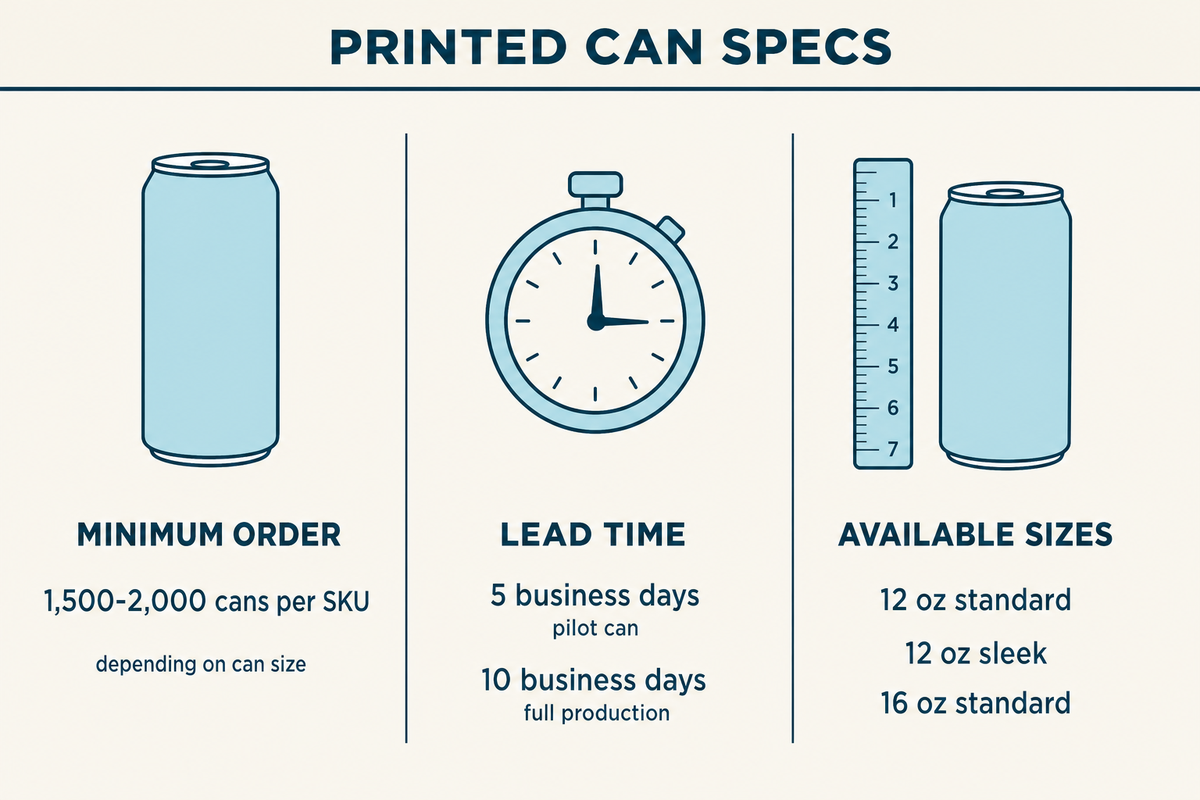
For context: Ball Corporation’s minimum for traditional printed cans is 5 truckloads per SKU, which works out to over 1 million cans. That’s more than most craft breweries produce in a year. Digital printing brings that minimum down by roughly 500x.
Something to consider: Compare the per-can cost to what you’re paying now for brites plus labels plus the labor to apply them (possibly even a label converter).
When Printed Cans Make Sense for a Brewery
Not every beer in your lineup needs a printed can. Here’s how we see breweries typically think about it:
Flagships and year-round beers: Your core lineup, the 3-4 beers that sell consistently. The designs are locked in, the volume is predictable, and these are the beers showing up on retail shelves next to nationally distributed brands. Printed cans make the most sense here.
Growing into distribution: If you’re moving beyond the taproom into larger retailers, distributors start caring about shelf presentation.
The mixed strategy: Most breweries don’t go all-in on printed cans overnight. They use printed cans for their core lineup and keep labels for seasonal releases, collaborations, and one-offs where they need lower minimums and faster design changes. That flexibility is one of the reasons digital works well for craft. You don’t have to choose one or the other.
Not sure if your brewery is at the right stage? Our post on when your brand is ready for printed cans walks through the specific signals to look for.
Available Finishes for Digitally Printed Cans
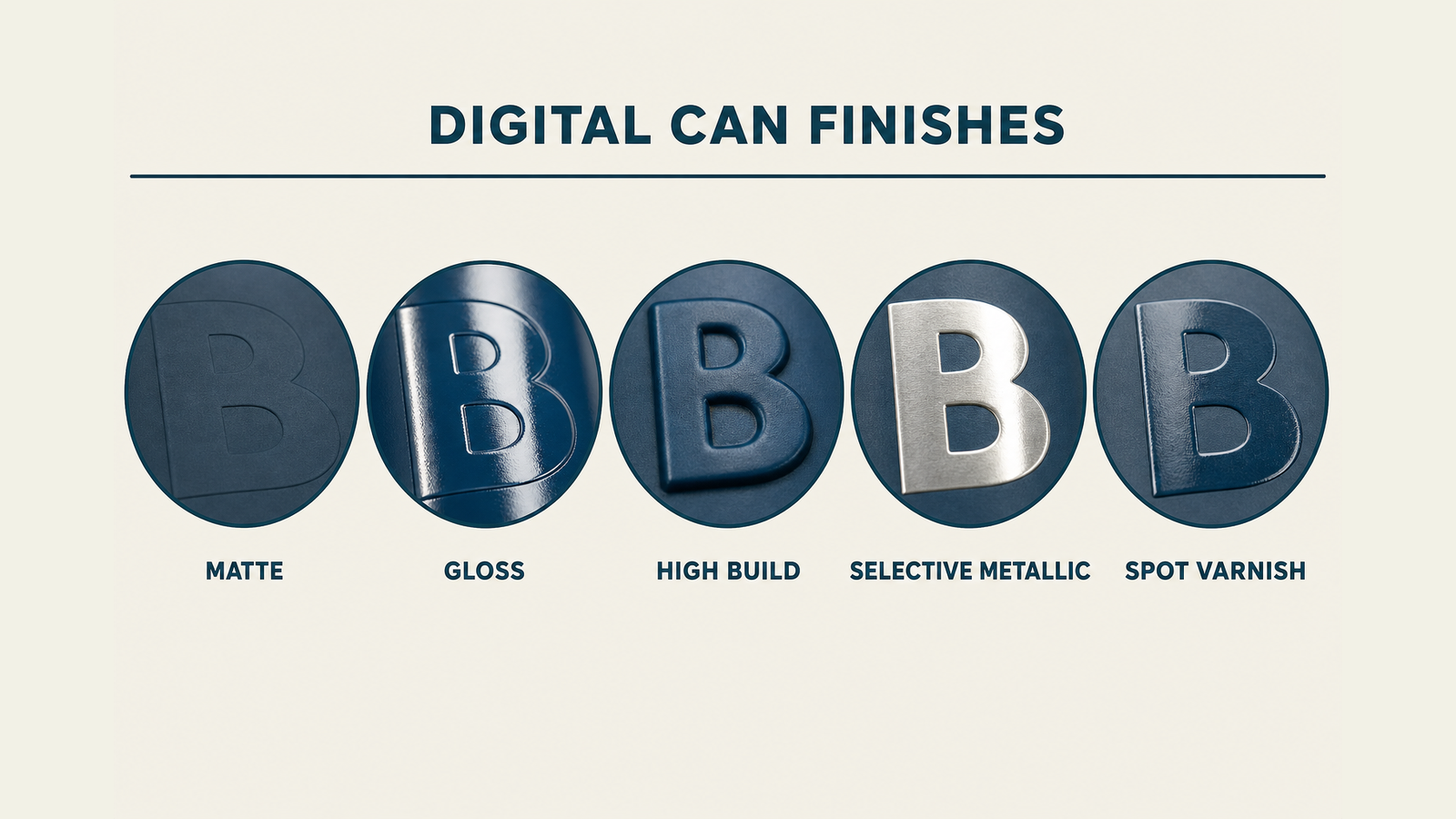
Digital can printing offers finishes that used to be reserved for the big brands:
- Matte for that soft, premium look (we see this a lot on hazy IPAs and NEIPAs)
- Gloss for a clean, bright look (popular for lagers, pilsners, and lighter styles)
- High build (emboss) for a raised, tactile effect you can feel when you pick up the can
- Selective metallic where the bare aluminum shows through your design, creating a natural metallic look without any additional printing layer
- Spot varnish applied to specific design elements for contrast (gloss logo on a matte background, for example)
Your designer will need to think about how artwork translates to a curved surface. Fine text needs to be 7pt or larger, barcodes work best in vertical orientation, and the areas near the top and bottom of the can have different curvature. Our guide to designing for printed cans covers the full spec.
Pilot Cans Let You Test Printed Cans Before Committing
The biggest risk in switching to printed cans is ordering thousands of cans and finding out the colors appear different than on your computer screen or the design doesn’t look right on a curved surface.
That’s why every new design starts with a pilot can. It’s a physical prototype printed on an actual can. You hold it, check the colors against your brand standards, and show it to your team before any production run begins.
Why Printed Cans Are the Most Recyclable Packaging Option
A printed can is just aluminum and ink. No label material, no adhesive, no plastic sleeve.
Aluminum is one of the most recycled materials on the planet. Printed cans go straight into the recycling stream without any separation step. Shrink sleeves, on the other hand, typically have to be removed before the aluminum can be recycled. In practice, most consumers don’t do that, which means sleeved cans often get rejected at recycling facilities.
If your brewery cares about sustainability (and your customers probably do), printed cans are the cleanest option.
Want to See Your Flagship on a Printed Can?
We’ve worked with over 1,500 breweries, so we’ve seen just about every setup. Whether you’re running 2,000 cans of your flagship or testing a new design for a seasonal release, the easiest way to start is with a pilot can.
Check out our printed cans page or request a quote and we’ll walk you through the details for your specific lineup.