What Label Materials Work Best in Freezer Storage?
Labels used in cold environments need to stick securely, survive moisture and condensation, and hold up to constant temperature swings.
If you’re choosing labels that must perform in these conditions, this guide breaks down what works, what doesn’t, and why.
Understanding Real-World Freezer Conditions
Before choosing a label material, it’s important to consider how and where labels will be applied and stored:
| Scenario | What to Consider |
| Application before freezing | Requires materials and adhesives that bond at temperatures above freezing (35°F or higher). |
| Application onto already frozen products | Needs cold-temperature application adhesives (down to -20°F or lower) with fast initial tack. |
| High-condensation environments | Materials must resist moisture absorption, edge lift, and ink smudging. BOPP excels here. |
| Flexible or contoured packaging (pouches, tubs) | Requires flexible facestocks like MDO or BOPP with conformability. |
| Long-term freezer storage | Requires durable facestock (BOPP) and freezer-rated adhesive that won’t fail over time. |
BOPP (Biaxially Oriented Polypropylene)
BOPP is the most commonly used freezer label material due to its durability, moisture resistance, and versatility.
Why BOPP Works in Freezer Environments:
- Moisture resistant: Won’t swell, distort, or absorb water.
- Stays flat and doesn’t curl or warp: flat, resists curling in freeze-thaw cycles.
- Flexible: Works on both flat and slightly curved surfaces.
- Cost-effective: Cheaper than other materials while offering stronger cold performance than coated paper.
Best Practices:
- Use rounded corners to prevent edge lift.
- Add laminate for extra moisture and scuff resistance.
- Often paired with freezer-rated adhesives for long-term performance.
Ideal for:
- Frozen food packaging (sleeves, pouches, containers).
- Pharma, medical, and nutraceutical products.
- Warehouse inventory labels.
Polyester (PET)
PET is a great option when you need labels that can handle rough handling, moisture, or long-term freezer storage.
Why PET Works in Freezer Environments:
- Built to handle heavy use, resist tearing, and stay intact over time.
- Resists scratches and holds up to handling, moisture, and product contents.
- Performs well in cold storage for long periods without breaking down.
Best Practices:
- Use on flat, rigid containers like metal, glass, or hard plastic.
- Add laminate if labels are exposed to abrasion or cleaning.
- Not ideal for curved or flexible surfaces.
Ideal for:
- Frozen meal trays, glass jars, or clear PET tubs.
- Health and beauty packaging like skincare bottles or bath product jars.
- Long-term frozen food packaging that needs to stay legible and durable.
MDO
MDO is best when you need a label that can flex, bend, or wrap around curved packaging.
Why MDO Works in Freezer Environments:
- Highly flexible, great for contoured or irregular surfaces.
- Durable and resistant to scuffs and handling.
- Can handle bending and squeezing without lifting.
Best Practices:
- Use when labeling tubs, pouches, or flexible packaging.
- Choose with laminate for added protection in cold environments.
- Avoid in harsh freezing conditions unless flexibility is required.
Ideal for:
- Wrap-around labels for tubs, bags, and flexible containers.
- Specialty or outdoor freezer applications.
- Irregular surfaces where BOPP or PET may lift.
Material Comparison Snapshot
| Material | Durability | Moisture Resistance | Flexibility | Cost | Best Use Case |
| BOPP | High | High | Moderate | $ | General-purpose freezer labels |
| PET | Very High | High | Low | $$ | Harsh handling or chemical exposure |
| MDO | High | Moderate-High* | High | $ | Flexible surfaces, specialty needs |
*Performance depends on adhesive and laminate selection.
Matching Material to Real-World Applications
| Packaging Type | Storage Condition | Label Stress | Recommended Material |
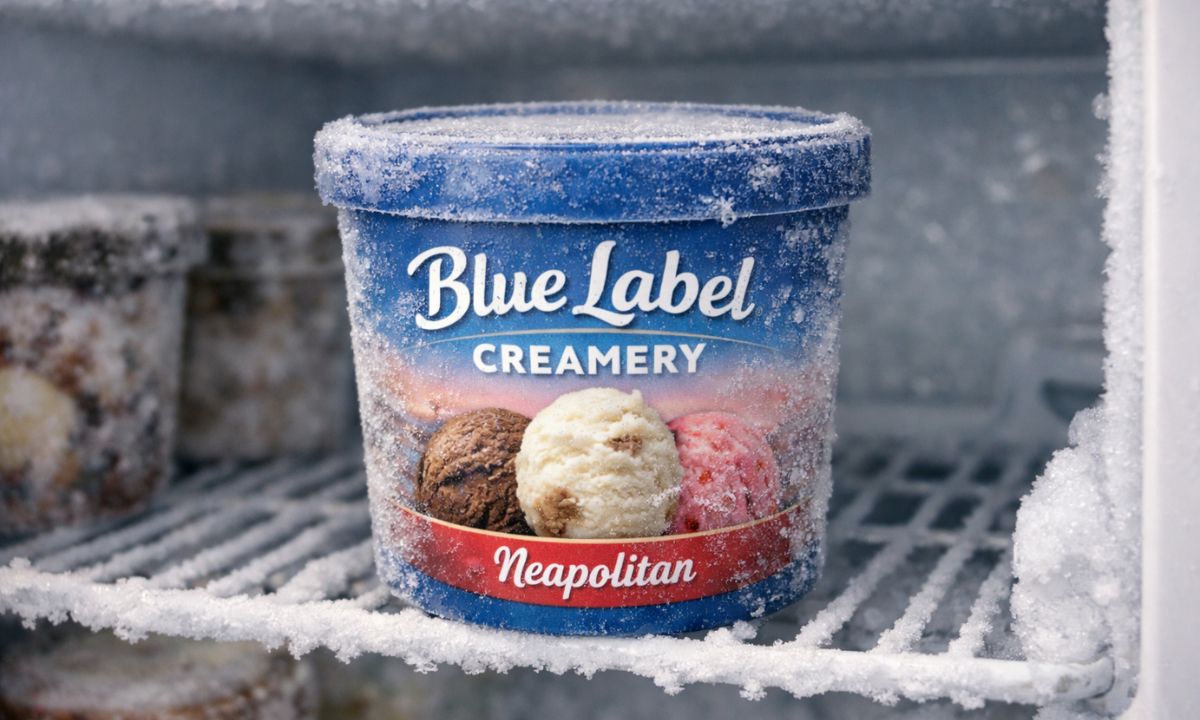
| Frozen ice cream tub (paper or cardboard) | Blast freezer, high condensation | Moisture, edge lift | BOPP + acrylic adhesive |
| Plastic pouch (LDPE/HDPE) | Commercial freezer | Flexibility, low-tack surface | MDO or BOPP with high-tack adhesive |
| Glass bottle with condensation | Upright freezer | Surface moisture, slipping | BOPP with high-tack adhesive |
| Warehouse rack labels | Long-term exposure, abrasion, scanning | Impact, tearing | PET, BOPP |
Label Materials for Freezer Storage
Freezer environments don’t forgive label mistakes. To avoid failures like peeling, curling, or smudging, start with the right material, and make sure it’s paired with the correct freezer-grade adhesive.
Need help choosing or testing materials for your packaging? Request a sample pack and we’ll help you find the right match for your exact conditions.