Dos and Don’ts for Non-Alcoholic Beer Labels
⚞ The Highlights:
- “Non-alcoholic” and “alcohol-free” aren’t interchangeable. “Non-alcoholic” means under 0.5% alcohol by volume and has to carry a specific disclaimer. “Alcohol-free” means 0.0%, with no wiggle room.
- A product under 0.5% can’t be called “beer.” It has to be a “malt beverage,” “cereal beverage,” or “near beer.”
- Who regulates your label depends on ingredients. Made from malted barley and hops? It’s a TTB malt beverage. Made without them? It falls under the FDA and needs a Nutrition Facts panel and ingredient list.
- The Government Warning usually doesn’t apply. A true non-alcoholic product under 0.5% is outside the rule that requires it.
Do: get the “non-alcoholic” vs. “alcohol-free” distinction right
These two phrases mean different things, and the TTB treats them differently.
- “Non-alcoholic” can be used on a malt beverage only if the statement “contains less than 0.5 percent (or .5%) alcohol by volume” appears immediately next to it, in legible print on a contrasting background. This is set in 27 CFR 7.65(e).
- “Alcohol-free” can be used only on a product that contains no alcohol at all (0.0%). There’s no tolerance, per 27 CFR 7.65(f).
That second one carries an extra step. Because “alcohol-free” promises 0.0%, the TTB requires formula approval with laboratory sample analysis to back up the claim before it will approve the label. That’s spelled out in TTB Guidance G 2016-1A. If your product has any trace of alcohol, call it “non-alcoholic,” not “alcohol-free.”
Don’t: call a sub-0.5% product “beer,” “ale,” or “lager”
The TTB reserves “beer” and its cousins for products at 0.5% alcohol by volume or higher. A product under that line can’t use “beer,” “lager,” “ale,” “porter,” “stout,” “malt liquor,” or any other designation normally used for full-strength beer. Instead, it has to carry one of three class designations: “malt beverage,” “cereal beverage,” or “near beer.” This is in 27 CFR 7.145.
You can still build your brand around the beer experience in your design and marketing. The class designation just has to be one of those three terms, shown clearly on the label.
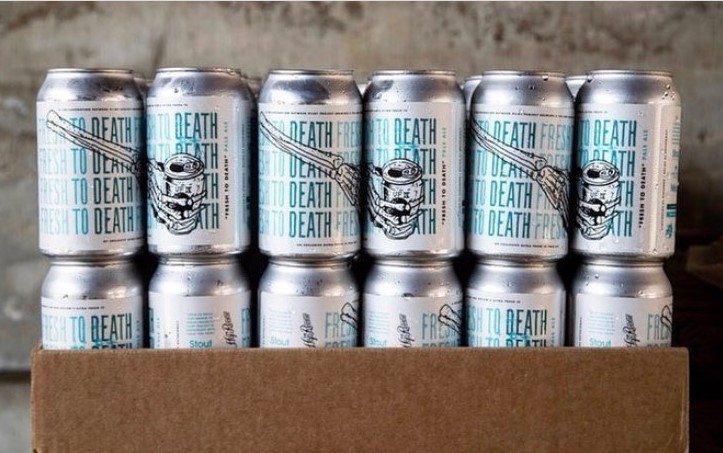
Worth knowing: This is one of the most common mix-ups we see on non-alcoholic labels. A brand will design a gorgeous “NA IPA” can and use “IPA” as the class designation. The art can say whatever fits your brand, but the official class designation on the label needs to be “malt beverage,” “cereal beverage,” or “near beer.”
Do: figure out who regulates your label first, the TTB or the FDA
This is the question that trips up the most NA brands, and it’s worth answering before you design anything. Whether your label follows TTB rules or FDA rules comes down to how the product is made, not just its alcohol content.
- Made from malted barley and hops (then brewed and dealcoholized): it’s a malt beverage under the Federal Alcohol Administration Act, so it stays under the TTB, the same as regular beer, even at 0.0% to 0.5%. The FDA confirms this in its guidance on dealcoholized malt beverages: these stay with the TTB “regardless of alcohol content.”
- Made without malted barley and hops (for example, brewed from other grains, or without hops): it doesn’t meet the malt beverage definition, so it falls under the FDA. That means it needs a full Nutrition Facts panel and ingredient list under FDA food labeling rules, per the FDA’s guidance on labeling certain beers.
So two non-alcoholic “beers” sitting next to each other on a shelf can follow completely different labeling rules. If you’re not sure which side of the line your recipe falls on, confirm it before you print. (For the bigger-picture version of why alcohol and food labels diverge, see our post on why beer, wine, and spirits labels don’t have to disclose ingredients.)
NA beer vs. regular beer: what each label needs
Here’s a side-by-side of the labeling differences, assuming your non-alcoholic product is a traditionally brewed malt beverage under the TTB.
| Label element | Regular beer (0.5% ABV or higher) | Non-alcoholic (under 0.5% ABV) |
|---|---|---|
| Class designation | “Beer,” “ale,” “lager,” “IPA,” etc. | “Malt beverage,” “cereal beverage,” or “near beer” only |
| “Non-alcoholic” statement | Not applicable | If “non-alcoholic” is used, must add “contains less than 0.5% alcohol by volume” adjacent to it |
| Government Warning | Required | Not required (product is under 0.5% ABV) |
| Brand name, net contents, name and address | Required | Required |
| Nutrition Facts panel | Not required (Serving Facts optional) | Not required if it’s a TTB malt beverage; required if the product falls under the FDA |
| TTB label approval (COLA) | Required for a malt beverage | Required for a TTB malt beverage; “alcohol-free” (0.0%) also needs lab analysis |
Do: know when the Government Warning applies, and when it doesn’t
The federal Government Warning is required on alcoholic beverages, which the rules define as products containing 0.5% alcohol by volume or more (27 CFR 16.10). A genuine non-alcoholic product under 0.5% falls outside that definition, so it generally doesn’t need the warning.
One caution: this is one of the few places where being just over the line matters a lot. If your product comes in at 0.5% or above, even slightly, it’s an alcoholic beverage in the eyes of the rule and needs the full Government Warning. Know your actual alcohol content before you decide.
Don’t: forget the tax marking on a true cereal beverage
If your product is a cereal beverage (a malt product under 0.5% that the brewer removes without paying beer tax), the bottle label has to carry the legend “Nontaxable under section 5051 I.R.C.” This sits in the brewery tax rules at 27 CFR 25.242, not in the main labeling part, so it’s easy to miss. It’s a small line, but leaving it off a cereal beverage label is a compliance gap.
Don’t: let the rules flatten your design
Non-alcoholic beer is a crowded, fast-growing category, and the label still has to earn the sale. Shoppers reaching for an NA option are often trying something new, and the can is what gets them to pick it up. The compliance pieces (class designation, the “non-alcoholic” line, any required panels) can all live cleanly on a well-planned layout without dulling the design.
This is where we come in. Whether your NA product is a TTB malt beverage or an FDA-regulated beverage, we’ll help you fit everything the label needs into artwork that still looks the way you want it to. Take a look at our craft beer label options, or reach out and we’ll talk through your project.
Frequently asked questions
Is non-alcoholic beer regulated by the TTB or the FDA?
It depends on how it’s made. A non-alcoholic beer brewed from malted barley and hops (then dealcoholized) is a malt beverage regulated by the TTB, the same as regular beer. A product made without malted barley and hops falls under the FDA and follows food labeling rules, which include a Nutrition Facts panel and ingredient list.
What’s the difference between “non-alcoholic” and “alcohol-free”?
“Non-alcoholic” means the product contains less than 0.5% alcohol by volume, and the label has to say “contains less than 0.5% alcohol by volume” next to the claim. “Alcohol-free” means exactly 0.0% alcohol, with no tolerance, and the TTB requires lab analysis to support that claim before approving the label.
Can you call a non-alcoholic product “beer”?
No. A product under 0.5% alcohol by volume can’t use “beer,” “ale,” “lager,” “porter,” “stout,” or similar terms as its class designation. It has to be labeled a “malt beverage,” “cereal beverage,” or “near beer.” Your branding and artwork can still center on the beer experience.
Do non-alcoholic beers need the Government Warning?
Usually not. The federal Government Warning is required on beverages with 0.5% alcohol by volume or more. A true non-alcoholic product under 0.5% falls outside that requirement. If your product is 0.5% or above, the warning is required.
Do non-alcoholic beers need a Nutrition Facts panel?
Only if the product is regulated by the FDA rather than the TTB. Traditionally brewed NA malt beverages (malted barley and hops) stay under the TTB and don’t require one, though some brands add a nutrition or Serving Facts panel voluntarily. Products made without malted barley and hops fall under the FDA and do need a Nutrition Facts panel and ingredient list.
Does a non-alcoholic beer need TTB label approval?
If it’s a TTB malt beverage, yes, it generally needs a Certificate of Label Approval (COLA) like any other malt beverage. An “alcohol-free” (0.0%) product also needs formula approval with laboratory analysis. FDA-regulated products don’t get a COLA, but they have to meet FDA food labeling rules.