What Is Dunnage and How Printed Cans Ship
⚞ The Highlights:
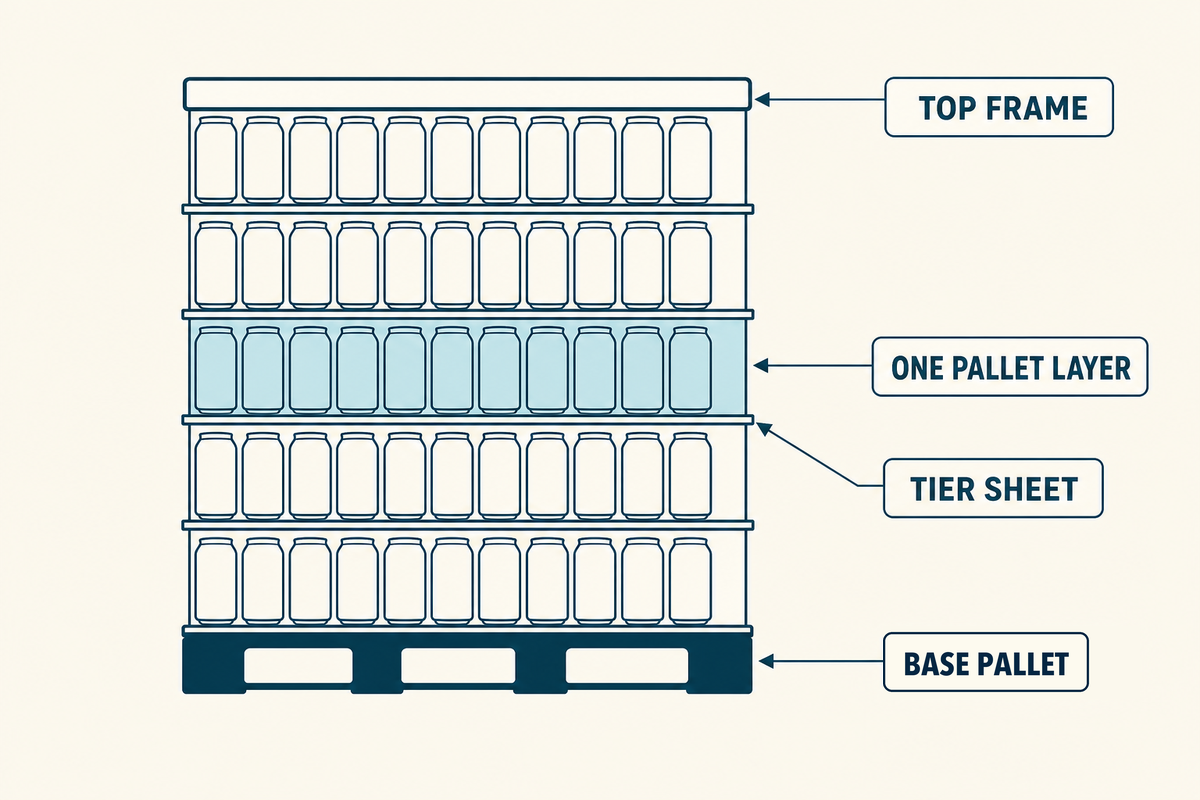
- Dunnage for cans is a plastic base pallet, tier (or separator/slip) sheets between each layer, and a top frame.
- Dunnage is billed on your order and credited back when it’s returned.
- You typically have 90 days from delivery to return dunnage.
- Look over every pallet before you sign for it, and write any damage on the delivery paperwork.
- If you’re booking your own freight, tell us first. A full pallet of cans is taller than some trucks and dock doors can handle.
Dunnage is the reusable packing gear that keeps empty cans from getting crushed on the way to you: a plastic pallet, plastic sheets between the layers of cans, and a frame on top.
If you’ve seen a dunnage charge on a printed can order, that’s what it covers, and you get the money back when you return the pieces.
Below, we’ll walk through how your printed cans are packed and shipped, what to check when they arrive, and how to send the dunnage back for your credit.
What Is Dunnage for Printed Cans?
In shipping, dunnage means any material that protects, steadies, or separates products in transit. For aluminum cans, it’s a three-part system that travels with every pallet.
- Plastic base pallet: the base your cans sit on.
- Tier sheets (also called separator or slip sheets): flat plastic-like sheets laid between each layer of cans, so every layer rests on a level surface.
- Top frame: a rigid frame on the top layer that keeps the stack square.
Why Do Empty Cans Need Dunnage?
An empty aluminum can weighs very little and dents easily. Until it’s filled and sealed, there’s nothing inside to help it keep its shape, and a single pallet can hold more than 8,000 of them stacked in tall layers.
How Are Printed Cans Packed and Shipped?
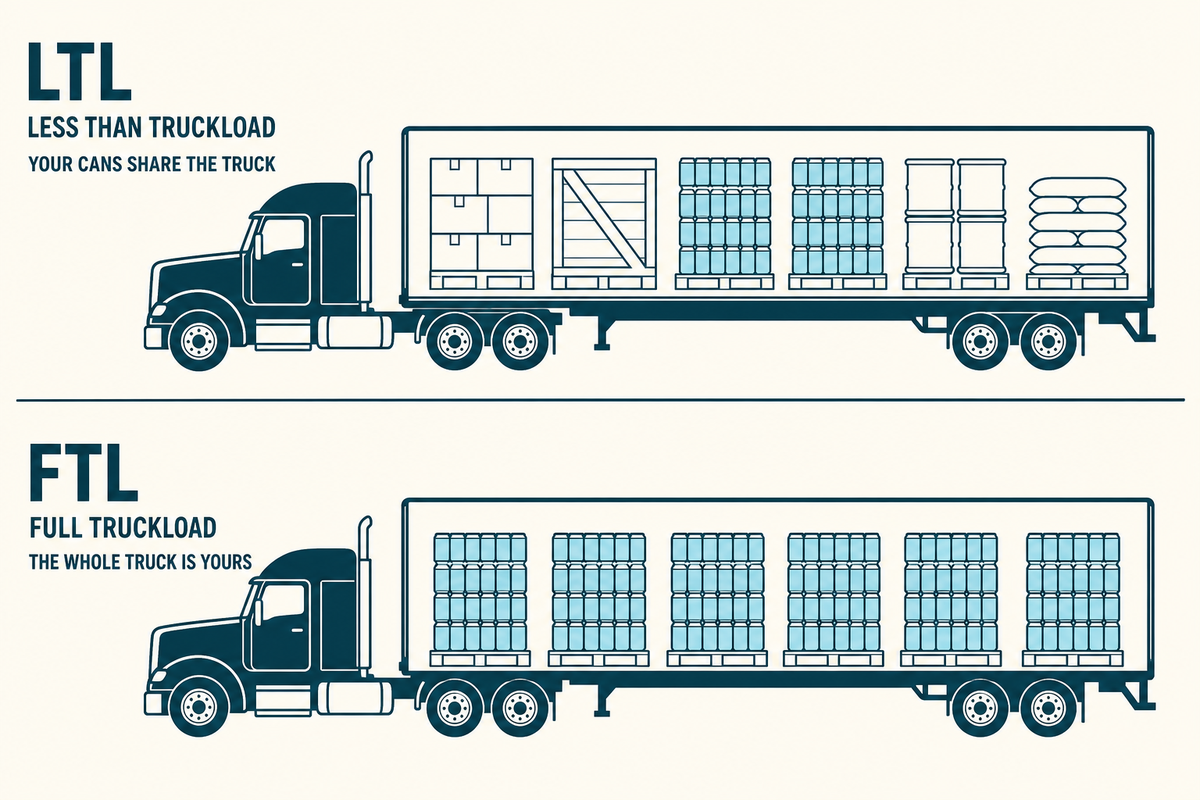
Printed cans ship in layers on pallets, and the number of layers depends on how the pallet is traveling. LTL (less than truckload) means your pallets share a truck with other companies’ freight. FTL (full truckload) means the whole truck is booked for your order. LTL pallets are built shorter, and FTL pallets stack a few layers higher.
| Can size | Cans per layer | LTL pallet (maximum) | FTL pallet (maximum) |
|---|---|---|---|
| 12 oz standard | 389 | 18 layers (7,002 cans) | 21 layers (8,169 cans) |
| 12 oz sleek | 506 | 14 layers (7,084 cans) | 16 layers (8,096 cans) |
| 16 oz standard | 389 | 14 layers (5,446 cans) | 16 layers (6,224 cans) |
Minimum orders are set in layers too, so a minimum run ships as a partial pallet.
Ordering several designs? They can share a pallet. Tell us which design you’ll fill first, second, and so on, and we’ll stack the pallet so the cans come off in that order.
Can You Arrange Your Own Freight for Printed Cans?
Yes. We ship LTL and FTL, and you’re welcome to pick up your order or book your own carrier.
Quick note: a full LTL pallet of cans is taller than some trucks, trailers, and dock doors can take. If you’re booking the freight, let us know before your order is packed. We may need to provide shorter pallets, and that changes the dunnage that ships with your order.
It also helps to tell us how you receive freight, such as whether you have a loading dock and a forklift on site. We’d rather plan around that up front than have a driver find out at your door.
Why Is Dunnage Billed on Your Printed Can Order?
Dunnage is billed on your order and credited back to you once it’s returned. It works a lot like a keg deposit: the charge covers equipment you’re borrowing, and the credit comes back when the equipment does.
That arrangement keeps the same pallets, sheets, and frames going out on order after order instead of heading to a landfill. It’s one of the less obvious parts of what makes printed cans a more sustainable package.
How to Return Dunnage and Get Your Credit
You have 90 days from delivery to return your dunnage. You can send it back to us or to a Crown warehouse. Crown supplies our cans and ends and has warehouses around the U.S. and Canada, so one may be closer to you than our printing facility.
| Where you send it | What happens next | When your credit posts |
|---|---|---|
| Blue Label Packaging | Our warehouse team receives and inspects it | After inspection |
| A Crown warehouse | You submit the return form with the carrier’s tracking number (sometimes called a pro number), and we confirm delivery | Once delivery is confirmed |
Our dunnage return form covers both routes. It asks how many pallets, top frames, and slip sheets you’re sending, whether you’re booking the freight yourself or need it arranged, and where and when the pickup can happen.
The form also asks you to confirm your dunnage is:
- Clean
- Undamaged
- Stacked properly
- Secured for the trip
Returned dunnage gets inspected before it’s credited. The simplest way to keep it in good shape is to stack pallets, sheets, and frames indoors as you empty each pallet, so they aren’t sitting out in rain or getting clipped by a forklift.
What to Check When Your Printed Cans Arrive
Before the driver leaves, walk around every pallet. A signed delivery receipt with no notes tells the carrier everything arrived fine, and that’s hard to walk back later.
- Look before you sign. Check for crushed corners, leaning stacks, torn or missing tier sheets, and cracked top frames.
- Write down what you see. Note damage on the delivery receipt or bill of lading (the shipping paperwork the driver hands you). “Pallet 2, top three layers dented on the left side” is far more useful than “damaged.”
- Take photos. Get the whole pallet first, then close-ups, before anything is moved.
- Let your account manager know. Especially if we booked the freight.
Keep in mind: a note on the delivery receipt starts the paper trail, but it isn’t a claim. Under federal freight claim rules, a claim has to be in writing, identify the shipment, and ask for a specific dollar amount. For interstate truck freight, federal law doesn’t let carriers give you less than nine months to file one.
Planning a Printed Can Order?
If you’re comparing freight options, planning a pallet with several designs, or want to know what delivery day will look like at your building, we’re happy to talk it through.
You can see sizes and finishes on our digitally printed cans page, get the bigger picture in Printed Cans 101, or reach out to our team. We’re here if you have questions.